Last updated October 2026
A key scratch in a supermarket car park, a scrape against a garage wall or a line of stone chips from the motorway: paint damage is part of owning a car in Auckland. Some scratches polish out in minutes, while others need the panel repainted to stop rust setting in. This guide covers how to tell how deep a scratch is, what you can fix yourself, how a professional repair works and what affects the cost.
★View the Best Panel Beaters in Auckland→How deep is the scratch?
Car paint is built up in layers: a clear coat on top, the colour coat underneath, then primer, then bare metal or plastic. How a scratch is fixed depends on which layer it reaches.
Clear coat only
- How to tell
- Fine line, often disappears when wet, a fingernail glides over it
- Usual fix
- Machine polishing
Into the colour coat
- How to tell
- Visible from most angles, a fingernail catches slightly
- Usual fix
- Localised repair and blend, or touch-up
Down to primer or metal
- How to tell
- White, grey or shiny metal showing, fingernail catches clearly
- Usual fix
- Fill, prime, repaint and blend
Dented with the scratch
- How to tell
- Panel is pushed in as well as marked
- Usual fix
- Panel beating, then refinishing
The fingernail test is a quick guide. If your nail catches in the scratch, it has gone through the clear coat and polishing alone will not remove it.
What you can fix yourself
Light clear coat scratches and swirl marks can often be improved at home with a scratch remover or polishing compound and a soft pad. Touch-up paint pens can cover small stone chips and stop bare metal from rusting, which is worth doing quickly. Be realistic about the result: touch-up paint seals the chip but rarely makes it invisible, and aggressive rubbing compounds can cut through thin clear coat and make the area look worse.
DIY is not a good idea on deeper scratches across a panel, anything on a metallic or pearl finish where the colour has to be blended, or scratches that have already started to rust.
How a professional scratch repair works
1. Colour matching. The car’s paint code identifies the factory colour, and computerised matching adjusts for fading so the new paint matches the car as it is now, not as it left the factory.
2. Preparation. The scratch is sanded back, filled if needed and primed. Most of a lasting repair comes down to this step.
3. Spraying. Colour and clear coat are applied in a controlled spray environment and cured properly.
4. Blending. The new paint is faded into the surrounding area or the neighbouring panels so there is no visible edge.
5. Cut and polish. The finish is machine buffed so the texture and gloss match the rest of the car.
Blending is why a repair on one panel sometimes involves painting part of the panel next to it. Metallic and pearl colours change slightly with the viewing angle, and blending is what makes the repair disappear.
Why not leave it?
Small scratches through to bare metal do not stay small. Once moisture reaches the metal, rust starts, creeps under the surrounding paint and turns a quick repair into a bigger one. Auckland’s salt air and humidity speed this up. Faded or peeling clear coat is a similar story: New Zealand’s strong UV breaks down clear coat on roofs, bonnets and boot lids, and once it starts to peel it cannot be polished back.
What affects the cost
There is no fixed price for scratch repair, because two scratches of the same length can be very different jobs. The main factors are:
- Depth, from a polish-only job to a full fill, prime and paint.
- Size and location, including whether the damage crosses onto a second panel.
- The paint, since metallic, pearl and tri-coat finishes take more work to match and blend.
- Panel material, as plastic bumpers need different preparation from steel panels.
- Whether a dent is involved, which adds panel beating before any paint.
Get a quote from photos or an inspection, and ask whether the repair will be blended, what paint system is used and what guarantee comes with the finish. If the scratch came from an incident covered by your policy, such as vandalism or a collision, it may be worth checking with your insurer before paying privately.
When a respray makes more sense
If a car has scratches on several panels, widespread faded clear coat or a colour that no longer matches from panel to panel, a full respray can be better value than a series of spot repairs. It is a much bigger job, with more preparation and time off the road, so it usually makes sense on a car you plan to keep.
Scratch repair at Evoke Bodyworks
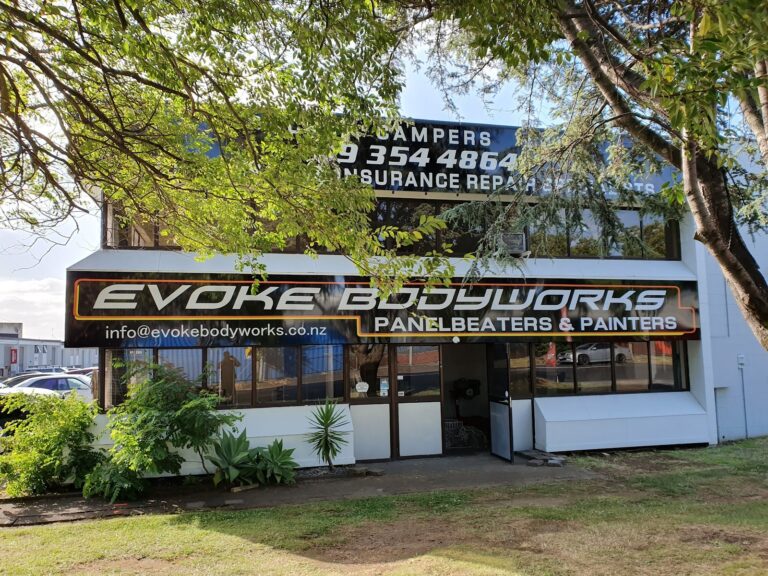
Evoke Bodyworks in Ōtāhuhu repairs scratches, chips and faded paint through its refinishing service. The team covers scratch, scuff and stone-chip repair, computerised colour matching to your factory paint code, single-panel resprays and blending, clear coat repair for faded or peeling paint, full repaints, and machine cut, buff and polish. Light scratches can often be machine polished out, and the workshop will recommend the most cost-effective option for deeper ones. Where a scratch comes with a dent, its panel beating team handles that first. Quotes are free, and you can send photos of the damage for an assessment. Evoke is on Saleyards Road in Ōtāhuhu and can be reached on 09 354 4864.