Last updated November 2026
Reformer Pilates has become one of the most popular ways to train in Auckland, but the machines can look intimidating the first time you walk into a studio. A reformer is a sliding carriage on rails, held back by springs, with straps for your hands or feet and a bar at one end to push against. It sounds complicated, yet most people find their first class far more approachable than they expected. This guide covers what reformer Pilates is, how it compares with mat classes, what happens in a beginner session, and how to choose an Auckland studio that suits you.
★View the Best Pilates Studios in Auckland→What Reformer Pilates Actually Is
Joseph Pilates developed his method in the early twentieth century, and the reformer is one of the pieces of equipment he designed to go with it. The springs under the carriage add resistance when you push or pull, but they also support you. That is why the same machine can challenge a fit athlete and help someone easing back into exercise.
How the springs work
Heavier springs usually make leg work harder, but in some exercises they give you more support and make the movement easier. Lighter springs let the carriage move more freely, which is often harder to control. Your instructor sets the springs for each exercise, so you do not need to know the settings before you start.
What it works
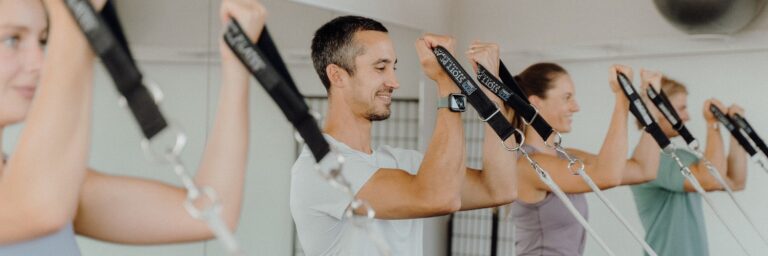
Most reformer exercises target the deep muscles around your trunk, hips and shoulders, with a strong focus on posture, breathing and control. A typical class mixes footwork, leg and glute work, arm work with the straps and core exercises, and usually finishes with stretches.
Reformer Pilates or Mat Pilates?
Both follow the same principles. The difference is where the resistance comes from and how much help you get.
Resistance
- Reformer Pilates
- Springs on a sliding carriage
- Mat Pilates
- Your own body weight, sometimes with small props
Support
- Reformer Pilates
- The springs can assist harder movements
- Mat Pilates
- No assistance, so some core exercises feel harder early on
Class size
- Reformer Pilates
- Limited by the number of machines
- Mat Pilates
- Often larger, as only floor space is needed
Practising at home
- Reformer Pilates
- Needs a reformer
- Mat Pilates
- Needs only a mat
Suits
- Reformer Pilates
- People who like hands-on guidance and feedback from the machine
- Mat Pilates
- People who want to practise between classes or while travelling
Many people do both. Mat work builds the same control you need on the reformer, and the reformer adds load as you get stronger.
Is Reformer Pilates Good for Beginners?
Yes, as long as the class is pitched at the right level. Because the springs can support you, a reformer often makes it easier to learn correct alignment than working on the floor alone. The bigger risk for a beginner is a fast class where nobody has time to check your position.
What to look for in a beginner class
- A small number of machines, so the instructor can see everyone
- An instructor who explains the springs and the safety basics before you start
- Options to make each exercise easier or harder
- A studio that asks about injuries before your first session
Who should check with a health professional first
If you are pregnant, recovering from surgery, managing a back or joint injury, or living with a heart condition, talk to your GP or physiotherapist before you start, and tell the studio when you book. If you would like physio-led Pilates, you can confirm a physiotherapist’s registration through the Physiotherapy Board of New Zealand.
What Happens in Your First Class
Before you arrive
Wear fitted clothing you can move in, because loose tops ride up when you lie on the carriage, and bring a water bottle. Many studios ask you to wear grip socks, both for hygiene and to stop your feet slipping on the footbar. Arrive ten minutes early so the instructor can show you how to adjust the headrest, shoulder blocks and springs.
During the class
Expect to start lying down, usually with footwork against the bar, then move through leg, arm and core sequences. Group classes generally run for around 45 minutes to an hour. Moving slowly is normal. Control is the point, and a smaller range done well is better than a big range done badly.
Afterwards
It is common to feel muscles you did not know you had, especially in the inner thighs, glutes and deep abdominals, for a day or two. That soreness usually eases as your body gets used to the work.
How Often Should a Beginner Go?
Two or three sessions a week, with a rest day in between, is the pattern many studios suggest while you are learning. Once a week still builds skill, and it is a realistic place to start if you also run, lift or play sport. Many people notice better posture and control within a few weeks, with strength changes following over a couple of months of regular practice.
Choosing a Studio in Auckland
Auckland has reformer studios from the central city to the North Shore, the eastern suburbs and South Auckland, so finding one is rarely the problem. The bigger question is whether the timetable fits your week. Traffic over the Harbour Bridge or along the Southern Motorway can turn a short drive into a long one at peak times, so a studio near home or work, with easy parking, makes it far easier to keep going.
- Check class sizes and whether there are beginner or foundation sessions
- Ask how the instructors are trained
- Look for a trial pack or introductory offer, so you can try a few classes before committing
- Read the cancellation terms for classes and memberships
Where Suna Pilates Fits
Suna Pilates has taught Pilates in Takapuna since 2000, from a studio at 1 Barry’s Point Road with free parking on site, handy to the motorway and about ten minutes from the city. Its 45-minute Reformer classes use STOTT Pilates reformers with a maximum of nine people in the studio, and every class is supervised by a Suna-trained instructor. For a first visit, the studio sells trial packs that combine Reformer and Pilates Fit classes, and its FAQ page covers the class types, opening times and booking through the app.